
Build AI-Powered Workflows and Intelligent Agents Without Coding from JHU
No-Code Generative AI and Agentic AI
 Application closes on
18th Jun 2026
Application closes on
18th Jun 2026
 Speak with our expert
+14104988288
Speak with our expert
+14104988288




Learn more about the course
Get details on syllabus, projects, tools, and more
No-Code Generative AI and Agentic AI
Application closes 18th Jun 2026
Why should you join this program?
-

No-Code Program to Build AI Agents and Intelligent Workflows
Build practical expertise in Generative AI and Agentic AI with Johns Hopkins University faculty and industry experts through real-world projects and case studies using no-code tools.
-
Learn from JHU, a Leading US Research University
Ranked #7 National University, #14 Best Global University, #2 in Computer Information Technology, reflecting JHU's leadership in research and innovation. (2026 Rankings)


PROGRAM OUTCOMES
What will you learn to build and apply?
Through a structured learning journey, you will build the capability to:
-

Understand key concepts in NLP, Generative AI, and Large Language Models (LLMs) through a no-code approach
-
Understand the fundamentals of creating effective AI prompts in business scenarios
-
Identify strategic business opportunities and industry use cases of GenAI and smart AI agents across sectors
-
Understand Responsible AI principles, risks, ethics, and compliance challenges
-
Understand AI agents, their evolution, and how they reason, act, use tools, and memory with real examples
-
Understand how no-code tools and RAG enable AI workflows and connect AI with business data
Earn a Certificate of Completion from Johns Hopkins University
-
#7 National University Rankings
U.S. News & World Report, 2026
-
#2 Computer Information Technology
U.S. News & World Report, 2026
-
#14 Best Global University
U.S. News & World Report, 2026
-
#1 Biomedical Engineering Program
US News and World Report, 2026

KEY PROGRAM HIGHLIGHTS
Why Choose This Program?
-
Learn from Johns Hopkins University Faculty
Learn through recorded lectures and attend faculty-led masterclasses covering Generative AI, Agentic AI, AI governance, emerging AI trends.
-
Interactive Mentorship by Industry Experts
Learn from AI experts through mentorship sessions focused on practical applications, implementation challenges, and industry best practices.
-
No-Code AI Curriculum
Build practical expertise in Prompt Engineering, RAG, AI workflows, intelligent agents, and AI evaluation, without programming.
-
Real-World Projects & Case Studies
Work on projects and case studies across sales, healthcare, finance, HR, logistics, customer support, and operations using AI workflows and agents.
-
Earn a Recognized Credential from Johns Hopkins University
Earn a Certificate of Completion and 9 CEUs from Johns Hopkins University upon successful completion of the program.
-
Personalized Program Support
Receive guidance from a dedicated Program Manager and academic support from subject matter experts.


Skills you will learn
Retrieval-Augmented Generation (RAG)
Prompt Engineering
Natural Language Processing (NLP)
Multi-Agent Systems
Agent Orchestration
Agentic AI Systems
GenAI Workflow Automation
Sentiment Analysis
LLM Applications
Classification Modeling
Data Preprocessing
Exploratory Data Analysis
Rule-Based Validation
Retrieval-Augmented Generation (RAG)
Prompt Engineering
Natural Language Processing (NLP)
Multi-Agent Systems
Agent Orchestration
Agentic AI Systems
GenAI Workflow Automation
Sentiment Analysis
LLM Applications
Classification Modeling
Data Preprocessing
Exploratory Data Analysis
Rule-Based Validation
view more
- Overview
- Learning Journey
- Curriculum
- Projects
- Tools
- Certificate
- Faculty
- Mentors
- Reviews
- Fees

Who is the program for?
Professionals aiming to automate workflows and drive business impact with GenAI & Agentic AI via no-code tools
-
Business Leaders and Functional Heads
Who need to automate enterprise-wide workflows, implement Agentic AI strategies, and drive organizational productivity without deep coding expertise.
-
Technology Professionals and Team Leads
Who needs to rapidly prototype, evaluate, and orchestrate complex multi-agent systems and RAG pipelines using no-code platforms.
-
Subject Matter Experts
Looking to ground AI in proprietary data, build specialized AI assistants, and enhance data-driven decision-making in high-stakes internal settings.
How is the program learning experience?
Our pedagogy is designed to ensure a holistic learning experience
-
Learn from Experts
Learn from JHU faculty and industry experts to build skills in Generative AI and Agentic AI
-
Learn By Doing
Apply Generative AI and Agentic AI concepts through hands-on projects and case studies
-
Earn a University Credential
Earn a certificate of completion and 9 CEUs from Johns Hopkins University
-
Get Support Throughout the Learning Journey
Program managers will help you stay on track, navigate key milestones & complete the program




What will you learn in the program?
The curriculum for the No-Code Generative AI and Agentic AI program is designed by the faculty of Johns Hopkins University and leading industry practitioners. It requires no prior programming experience and focuses on the architecture and orchestration of complex, trustworthy Agentic AI systems using no-code platforms and cutting-edge tools.
-
Masterclasses
By JHU Faculty
-
Live Mentorship
By Industry Experts
-
Self-Paced
Modules
Pre-Work
This preparatory course introduces the role of no-code platforms such as n8n in building AI-powered workflows without programming. You will explore key components of n8n, including nodes, triggers, and integrations used to connect applications and services. The module also guides you in designing simple automated workflows to orchestrate tasks and integrate AI capabilities into business processes.
Concepts Covered
Course 1 | Gen AI and Agentic AI Foundations
This course introduces the fundamentals of Generative AI and Agentic AI, highlighting their evolution and real-world applications. Learners will explore practical frameworks and prompting techniques to effectively interact with AI systems and improve output quality, with a focus on accessible, no-code implementation.
Week 1 | Gen AI and Agentic AI Landscape
Case-Study | Retail
Week 2 | Prompt Engineering 101
Case Study | Human Resources
Course 2 | Building No-Code Gen AI Workflows
This course focuses on applying Generative AI to analyze and extract insights from unstructured business data. Learners will develop skills in prompt engineering, evaluating AI outputs, and building context-aware systems that integrate external knowledge sources. The course also covers techniques to improve reliability and connects AI models to real-world business data for practical applications.
Week 3 | Prompt Engineering and NLP Tasks
Case Study | Finance
Week 4 | Evaluation of Gen AI Workflows
Case Study | Finance
Week 5 | Building Workflows on Proprietary Data with RAG
Case Study | Healthcare
Week 6 | Hands-On Project
Week 7 | Learning Break
Course 3 | AI Agents for Productivity
This course focuses on designing and managing autonomous AI agents to achieve defined goals. Learners will explore agent frameworks, build workflows with human oversight, and develop multi-agent systems for complex tasks. The course also covers performance optimization, cost efficiency, and implementing guardrails to ensure responsible and secure AI deployment.
Week 8 | Introduction to Agents
Case Study | Finance
Week 9 | Evaluating Agentic AI Workflows
Case Study | Logistics
Week 10 | Multi-Agent Systems and Collaboration
Case Study | Customer Support
Week 11 | Responsible AI
Case Study | Telecommunications
Week 12 | Hands-On Project
Anthropic Masterclass
This self-paced masterclass introduces the role of Anthropic and the capabilities of Claude models. You will explore concepts such as Constitutional AI, safety, and alignment, and apply effective prompting techniques to generate structured outputs. The masterclass also covers basic API usage, simple application development, model comparisons, and key ethical considerations in deploying AI systems.
Concepts Covered
Self-Paced Module | Claude-Based AI Workflows
This module is designed to build practical capability in applying Generative AI and Agentic AI using the Claude ecosystem in real-world contexts. Participants build the ability to design, execute, and evaluate AI-driven workflows for real-world applications, supported by ~5 hours of structured learning.
Design and Execute AI Workflows
Build and Deploy AI Systems at Scale
What projects will you work on?
Work on projects covering Prompt Engineering, RAG, AI agents, workflow automation, and AI governance

Operations
PolicyBot: Private Document RAG Assistant
Description
Create a “chat with your PDF” system to query internal manuals, connecting AI to company information and grounding responses in private data to address knowledge gaps.
Skills you will learn
- Retrieval-Augmented Generation (RAG)
- GenAI Workflow Automation
- Document Extraction
- Querying

Sales
Autonomous Multi-Agent Sales Intelligence System
Description
Orchestrate a virtual multi-agent system to automate B2B lead qualification, leveraging specialized agents to manage hand-offs, conduct research, and ensure secure approvals within an AI-driven workflow.
Skills you will learn
- Multi-Agent Systems
- Workflow Automation
- Agent Orchestration
Which tools will you learn and apply?
Learn no code tools like Claude, Gemini, NotebookLM, and n8n to build AI workflows and intelligent agents
-
ChatGPT
-
n8n
-
NotebookLM
-
Gemini
-
Claude





Earn a Certificate of Completion from Johns Hopkins University
Stand out in a competitive market with a Certificate of Completion in No-Code Generative AI and Agentic AI that validates the expertise developed through rigorous, practical assessments.
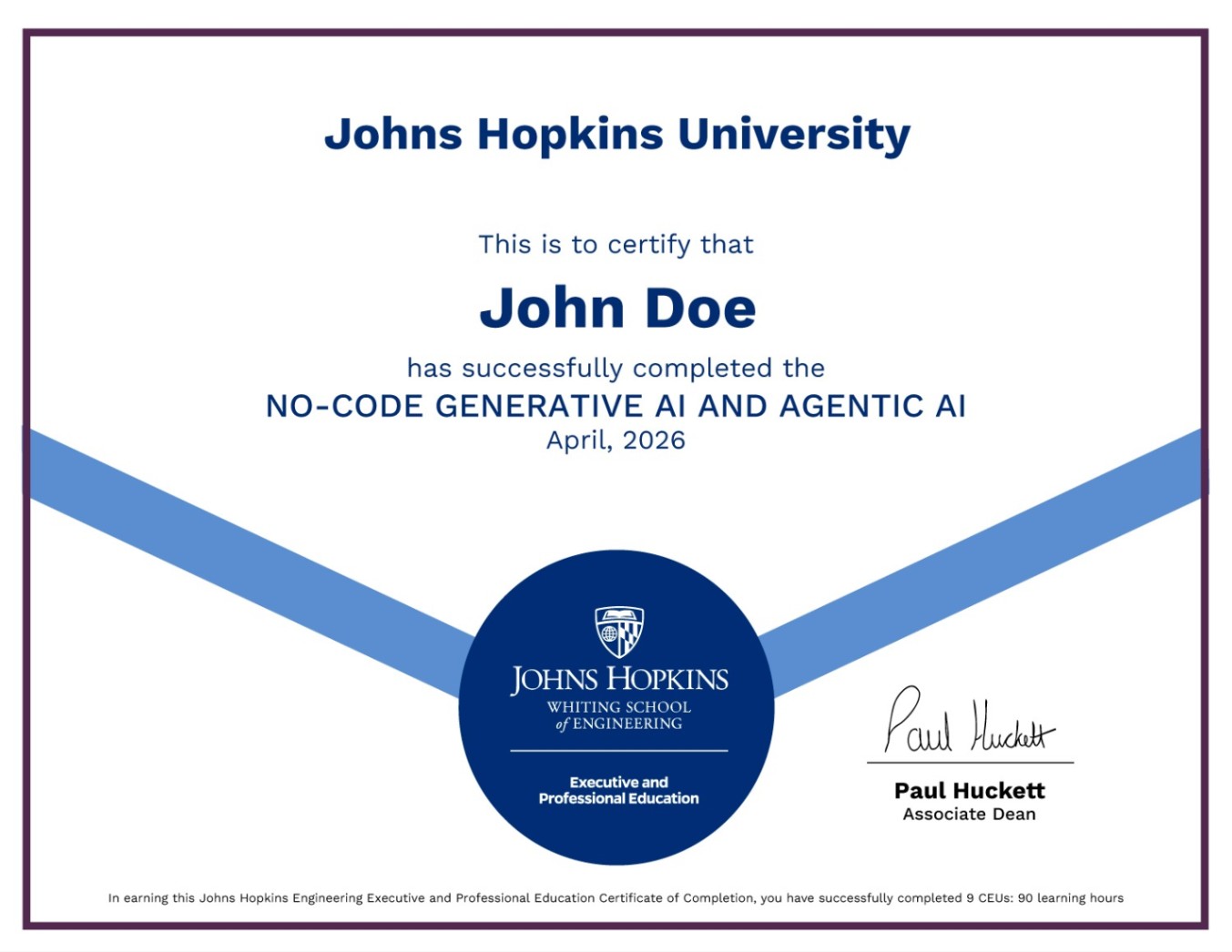
* Image for illustration only. Certificate subject to change.
Who are the faculty for the program?
Learn from renowned JHU faculty and build the expertise to implement and scale AI solutions across functions
-
Dr. Ian McCulloh
Director of AI Executive & Professional Education, Johns Hopkins University
Served as Chief Data Scientist and MD, AI, Accenture Federal Services
Author of three books and over 100 peer-reviewed papers
Know More
-
Dr. Abhinanda Sarkar
Senior Faculty & Director Academics, Great Learning
30+ years of experience in data science, ML, and analytics.
Ph.D. from Stanford, taught at MIT, ISI, and IIM Bangalore.
Know More



 LinkedIn Profile
 University Link
Who are the mentors for weekly live sessions?
Learn from seasoned AI healthcare mentors to apply concepts and build practical skills
-
Dr. Sunil Kumar Vuppala
AI Partner, ArisGlobal
-
Randhir Agarwal
Director, Data Science & Data Engineering, Samsung Electronics
-
Balachandra Deshpande
Head of Data Science, Enterprise Minds, Inc
-
G Anthony Reina
Head of Machine Learning, Stealth BioTech Startup
-
Jeremy Samuelson
Executive VP, AI and Innovation, Integrated Quantum Technologies
.jpeg "Dr. Sunil Kumar Vuppala - Mentor")

.jpeg "Randhir Agarwal - Mentor")
.jpeg "Balachandra Deshpande - Mentor")





Course Fees
The course fee is USD 3,100
Invest in your career
-
Build practical skills in Generative AI, RAG, AI workflows, and intelligent agents through hands-on learning
-
Dedicate 8-10 hours weekly to faculty-led learning, industry mentorship, projects, and case studies
-
Learn from AI experts in weekly live online sessions focused on real-world implementation and business impact
-
Receive a Certificate of Completion and 9 CEUs from Johns Hopkins University


Easy payment plans
Avail our EMI options & get financial assistance
-
discount available
USD 3,100 USD 2,900
Third Party Credit Facilitators
Check out different payment options with third party credit facility providers


*Subject to third party credit facility provider approval based on applicable regions & eligibility

Application Process
Applications close once the required number of participants enroll. Apply early to secure your spot
-
Fill the application form
Apply by completing the online application form.
-
Application screening
A panel from Great Learning will review your application to determine your fit for the program.
-
Join the program
Receive an offer for a seat in the upcoming cohort of the program after a final review


Batch Start Date
-
Online · To be announced
Admissions Open
 Application closes
18th Jun 2026
Application closes
18th Jun 2026


Hey there! Welcome back.

Forgot your password? No problem.

You are already registered. Please login instead.
Login
Forgot Password?
Enter your registered email and we'll send you a link to change your password.